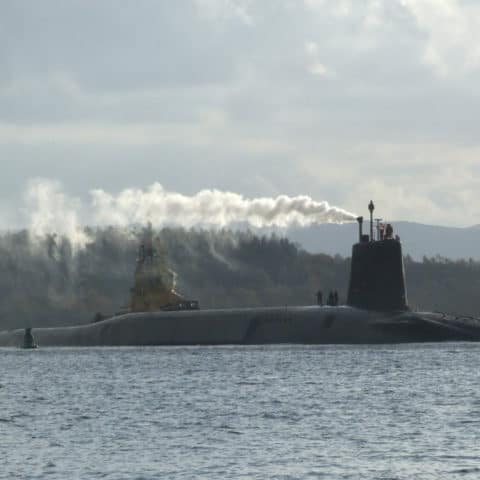
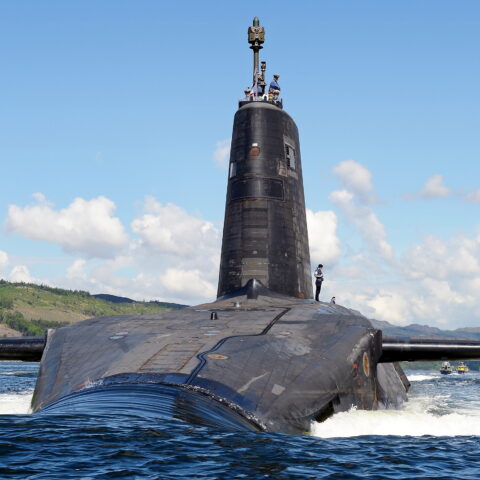
Displaying items by tag: Trident
Monday, 30 January 2012 09:27

Trident: Nowhere to Go

Trident: Nowhere to Go, published in January 2012, is a detailed analysis of government archives. These documents discussed various possible locations for siting Polaris, Trident's predecessor. In light of recent developments toward a possible independence referendum in Scotland, this timely report analyses, using the MoD's own assessments, why alternative locations to Faslane and Coulport in Scotland are simply not tenable.

With locations including the 2012 Olympics sailing venue, National Trust land and densely populated residential areas, there is simply nowhere for Trident to go.

Trident: Nowhere to Go is a joint publication by CND and Scottish CND.

Written by: John Ainslie

Researched by: John Ainslie & Brian Burnell


Published in Trident Briefings
Friday, 09 December 2011 11:50

MoD softens under pressure on Trident

The Campaign for Nuclear Disarmament today welcomed the Ministry of Defence’s admission that it may yet publish findings from the Trident Alternatives Review. The MoD also confirmed that spending commitments now totalling £6 billion will not be used to influence the parliamentary decision due on Trident replacement in 2016.

The Government has been under increasing pressure over its attempts to bury the Trident Alternatives Review. Defence Secretary Philip Hammond stated recently that there were ‘no plans’ to make the Lib Dem-led review into alternatives to Trident replacement public.

But Wednesday’s debate on Trident revealed a softening of the MoD’s position on the report. Junior Defence Minister Peter Luff stated that although the MoD would ‘not be able to publish the study itself’ on ‘national security’ grounds, ‘no decisions have yet been taken about what it might be possible to say’. [1]

The Government has also faced fierce criticism over its commitment to spend a total of £6bn on both the submarines, prior to the construction decision in 2016, and on nuclear weapons facilities at the Atomic Weapons Establishment (AWE) in Aldermaston. Peter Luff claimed, however, that ‘nothing that we are doing will prevent us from being able to make the right decision in 2016.’

CND General Secretary, Kate Hudson, said:
‘These are small but significant developments for all of us worried about a lack of transparency and accountability over Trident replacement. Concerns have been expressed that so much money will have been spent up front that we will be presented with a fait accompli in 2016 – that we will have to go ahead because of the money already spent. But now Peter Luff has quite categorically reassured us that will not be the case. We welcome that.

‘We also welcome the possibility – confirmed by the Minister – that some of the findings of the Trident Alternatives Review may be made public. Following concern that debate will be suppressed, it is good to know that the Government is responsive to public feedback. Given that this is our money being spent and our security that is being put at risk by government plans to replace Trident, we will continue to work for a full and transparent review of Britain’s nuclear weapons possession’.

Pressure from a cross-party range of MPs has also mounted, with Caroline Lucas (Green) describing the cost of replacing Trident as ‘eye-watering’, while Liberal Democrat MP Tessa Munt called it a ‘ludicrous waste of money’. Jeremy Corbyn MP (Labour) warned that the pressure must be maintained if the public want to avoid ‘sleepwalking’ into ‘massive levels of expenditure’.

[1]http://www.publications.parliament.uk/pa/cm201011/cmhansrd/cm111207/halltext/111207h0002.htm#11120744000555

Published in Trident

Ahead of speaking at a fringe meeting on Trident replacement tonight at the Liberal Democrat party conference (see note below), CND General Secretary Kate Hudson has made the following statement.

A longer version can be read on her blog.

"As an anti-nuclear campaigner, I welcome the Trident Alternatives Review, led by Defence Minister Nick Harvey, and his refusal just to roll over in the face of Liam Fox's antiquated adherence to the so-called 'deterrent' in all its cold war glory. What is not so great, and which no doubt irks most Lib Dem members as much as me, is that Nick Harvey's Alternatives Review is not considering the Alternative of nuclear disarmament - only nuclear alternatives.

Recently I wrote to Nick Harvey to express my concern about the failure to consider the non-nuclear alternative. No doubt like many other correspondents on this issue, I received a serious and detailed reply from the Ministry of Defence. But the contents of the reply were disappointing. It confirmed the Coalition Agreement which stated that Britain would maintain a 'minimum credible nuclear deterrent' while stressing that Lib Dems could continue to make the case for alternatives. The emphasis is on reduction and multilateral initiatives.

In my opinion, this is an enormous missed opportunity and is out of synch not only with Lib Dem grass roots' opinion, but with the majority of the British population whose concerns about levels of spending on Trident has led to consistent majority demand for the scrapping of Trident. Ironically though, it is not only out of step with opinion polls, but actually the government's own strategy and analysis - although they are not willing to  recognise the implications of that.

Nick Harvey and the Lib Dem leadership have gone half-way on Trident, but they owe it to their party - and the country - to go the whole way, to have the vision and leadership to advocate nuclear disarmament.

With the final decision on replacement coming up in 2016, there is no doubt Trident will be an issue in the next general election. Lib Dem policy on Trident will be crucial to the outcome, but if the Alternatives Review shapes Manifesto policy and means the Lib Dems go into the election with a pro-nuclear policy, that will be a bitter blow to peace and disarmament.

I, for one, hope that the Lib Dem election manifesto will boldly state its opposition to any nuclear replacement for Trident: the non-nuclear option must be in the Alternatives Review."


-ends-


1. For further information and interviews please contact CND's Parliamentary Officer Ben Folley on 07968 420 858 or Kate Hudson on 07968 420859.  

2. Kate Hudson will speak at a fringe meeting on Britain's nuclear weapons at 8pm, Sunday 18th September, Room 4 of Jury's Inn, Broad St, Birmingham. Speakers alongside her will be Steve Gilbert MP of the Lib Dems International Affairs Parliamentary Committee and Peter Burt of the Nuclear Information Service. The meeting has been organised by the Lib Dem members group Say No To Trident.

Published in Trident

The Campaign for Nuclear Disarmament today welcomed the reduction in the number of warheads deployed on one of the UK’s Vanguard class submarines, announced in a written statement by Liam Fox today. This has taken place as ministers from the US, Russia, UK, France and China (P5 countries) are holding talks on nuclear disarmament in Paris from today (29th) until Friday (1st July).

Kate Hudson, General Secretary of the Campaign for Nuclear Disarmament, said “This is a welcome step towards Britain living up to its commitment to disarm itself of nuclear weapons and we urge the government to rapidly expedite the reductions on all four submarines. However, this is only a small stage on the way to fulfilling our disarmament obligations. Even when the current reductions are completed in the 2020s, Britain will still have 180 of these city-destroying bombs.

“The legally binding commitment of the five original nuclear powers – Britain included – is not to nudge down their numbers of warheads. It is to rid themselves of these monstrous weapons entirely. This was the grand bargain of the nuclear Non-Proliferation Treaty which was struck in return for other states renouncing nuclear weaponry – a deal which becomes ever more fragile whilst there is limited progress on disarmament.”

Ministers meeting today in Paris are following up on the commitments they made at the nuclear Non-Proliferation Treaty (NPT) Review Conference at the UN last year.

At the conclusion of the 2010 NPT meeting, the five original nuclear weapon states agreed to "accelerate concrete progress on...steps leading to nuclear disarmament". The conference on ‘Confidence Building Measures towards Nuclear Disarmament and Non-Proliferation’ will discuss what mutual steps may be taken by the five countries.

Kate Hudson continued, “International agreements to ban other weapons of mass destruction - chemical and biological weapons – have been rapidly negotiated once governments committed seriously to ridding themselves of them in parallel. A nuclear weapons convention – ridding the world of all nukes held by the P5 and others – is a necessary and achievable goal. We strongly urge the UK government to put such a plan on the P5 conference agenda and to make a major contribution towards achieving this by cancelling the replacement of Trident entirely.”

Yesterday MPs Caroline Lucas MP (Green Party), Jeremy Corbyn (Labour) and Eilidh Whiteford (SNP) joined campaigners to deliver a letter to David Cameron calling on him to develop a national action plan to eliminate the UK's stockpile of over 200 city-destroying nuclear weapons. A photo is available at http://www.cnduk.org/images/stories/images/globalabolition/nuclear-abolition-day.jpg

Published in Trident
Friday, 20 May 2011 00:00

Cost of Trident doubles

The recent announcements on Trident's replacement have exposed ever greater layers of conflict and contradiction at the top of the coalition government. Liam Fox confirmed that the subs would cost around double the previously stated price (pdf) - now up to £25 billion (pdf).

He also authorised billions of pounds of spending prior to the final decision being made in 2016. In his view, quite clearly, new submarines will go ahead and everything nuclear will stay the same. Yet simultaneously, he announced that there would be a study, led by Liberal Democrat Defence minister Nick Harvey, into alternatives to the Trident submarine-based system.

Of course, Fox was reported as rubbishing the study as a "joke", indicating that he knew the outcome before it has even started. But he is after all the champion of the Tory right, and it is clearly infuriating for him to have to make concessions to the Lib Dems. Indeed, other gung-ho pro-nuclearites were verging on the apoplectic.

The Labour front bench was hardly worthy of a mention, backing the so-called minimum independent nuclear 'deterrent'. Normal people call them nuclear weapons.

No matter how irritated one might be about Lib Dem u-turns, they do seem to be hanging in there on the Trident question. It would be easy to dismiss this as posturing to try and salvage some of the radical edge they have otherwise lost, but I suspect it is rather more complex than that. Although Fox has announced the intended purchase of so-called 'long-lead items' for the new subs, the reality is that Trident's replacement is not nailed down. The final purchase and manufacture decision point is not taking place until 2016. There is a study into alternatives which many heavy weight politicians from all parties will support.

Yesterday's events, for me, only confirmed that it is not only the Lib Dems in the coalition government who are unconvinced about replacing Trident, otherwise they would not be getting as far as they are with it.

There must be a question mark hanging over it at some pretty high levels. That was abundantly clear from reading the new National Security Strategy issued last autumn.

Tier one threats were cyber warfare, weather incidents and pandemics; state on state nuclear attack was reduced to tier two. Now we need enough forward-looking politicians with the determination to abandon Cold War dogma and irrelevant status arguments and spend the money on something more useful.

Published in Kate Hudson's blog
Thursday, 12 May 2011 00:00

Scotland's new anti-Trident majority

For the last 4 years Scotland has been governed by a minority SNP administration. Most people believe it has been reasonably competent if also pro-business. But many of its key policies were not implemented as it lacked a parliamentary majority. Not any more. On Thursday 5th May the people of Scotland voted for a new Scottish Parliament.

The outcome was a dramatic and sweeping victory for the Scottish National Party, a party which had been trailing ten points behind Labour in the opinion polls just a few weeks earlier. By polling day, the SNP's victory was widely predicted, but the sheer scale of it took everyone by surprise. The Liberal Democrats were punished for participating in the hated Coalition Government. Their vote collapsed across Scotland and most of it went to the Nationalists. The Tory vote also went down by 2-3% and their tally of seats fell from 20 down to 15. Labour, which conducted a disastrous campaign under the hapless Ian Gray, lost a significant part of its core vote as 'safe' seats in Labour's heartlands in Glasgow and Lanarkshire fell like ninepins and huge majorities were overturned.

What does this mean for the peace movement? The new SNP government has a clear and unambiguous majority of 69 out of 129 seats. If we add at least 4 Labour rebels, 2 Greens, 1 independent, and possibly one Liberal Democrat, that makes 76 or 77 anti-Trident votes in the new parliament. Defence, of course, is a reserved issue and the new government cannot afford to face a legal challenge by attempting to go beyond its powers. But its hands are now much freer than before.

In June 2007 the Scottish Parliament passed a resolution calling on the UK government to reconsider its decision to go ahead with Trident replacement, but the language had to be carefully amended to bring the Liberal Democrats on board. No such problems now exist. A stronger resolution which calls on the UK government to remove Trident and all nuclear weapons from Scotland could be passed within weeks and have a huge impact at home and abroad.

And, remember, if Trident is removed from Scotland it is likely to be scrapped. It would be prohibitively expensive to relocate elsewhere, even if a suitable site could be found. If the UK government turns a deaf ear to the demands of Scotland's parliament, it could boost the yes vote in a future independence referendum. The Scottish election result gives us a unique opportunity to build a formidable alliance of people and parliament against Trident. We must grasp it with both hands.

Published in Kate Hudson's blog
Monday, 04 April 2011 14:39

Triple track on Trident

Lib Dem Defence Minister Nick Harvey seems to be taking the government's coalition agreement at face value. When the Conservatives and Lib Dems negotiated their way into government together, one of the many differences of view was over Britain's Trident nuclear weapons system. During the election campaign, Nick Clegg had made a big feature of his party's opposition to 'like-for-like' replacement of Trident: whether it should be replaced with cheaper nukes, or even no nukes, remained an open question. And so, when it came to the coalition agreement, Lib Dems retained the right to argue for alternatives to Trident.

Now we hear that Nick Harvey - the top Lib Dem in the MoD - is ploughing an interesting furrow. According to recent reports, he has called for an Anglo-French nuclear co-production, jointly developing and running new nuclear weapons. This, he surmises, would save Britain tens of billions of pounds. Apparently he floated this idea at the French Ambassador's residence recently and he says it was warmly received. That's not so surprising given that Sarkozy had originally made a similar suggestion to Gordon Brown, who had rejected it.

Britain and France have already signed a nuclear cooperation agreement - last autumn they agreed some joint work on nuclear warheads. But Harvey's proposals seem to be on a totally different scale. One key question now is, where is Harvey taking Lib Dem policy on this, and is the party on side? The orientation within the Lib Dems is really either to get rid of nukes altogether or to downgrade them and diminish their salience. Although there is an argument that sharing nukes, rather than having your own, does effectively downgrade them, it could also be the case that tying British nukes in to France would also reduce the possibility of Britain making a sovereign decision to disarm.

The other big question is whether the government has a coherent view on its nuclear weapons policy? At the moment there now appear to be three tracks on offer: no decision on replacement until 2016; going-ahead now and buying parts irrespective of parliamentary approval; and doing it all with the French instead. And that's just within the government! What better case can there be for having a full review of Trident and all the options?

Published in Kate Hudson's blog
Summary to follow.
Published in Trident Briefings
Wednesday, 01 March 2006 21:56

CND Submission to Defence Select Committee

Summary to follow.
Published in Trident Briefings
Wednesday, 01 November 2006 21:55

CND Alternative White Paper

This paper calls on the government not to replace the Trident system, arguing this is the best policy for UK national security as it will lessen the dangers of nuclear proliferation and a new arms race, as well as meeting UK treaty obligations and freeing large sums of money for public services and social goals.

It notes that nuclear weapons will provide no protection against terrorist attacks, and have no rationale in a world where the UK faces no substantial nuclear threat.

Published in Trident Briefings
<< Start < Prev 1 2 3 4 5 6 7 8 9 10 Next > End >>
Page 1 of 10